Peyton Manning: PSI Or HGH?
You decide.
PSI or HGH?
You decide.

PSI or HGH?
Watch as the NFL and their media lackeys circle the wagons around Peyton Manning. At least he's not accused of deflating footballs.


Not us. But it could have been.
Soon after we decamped from Amherst and academia to Boston and a Phillips Street apartment on the back of Beacon Hill in June 1968, Bobby Kennedy was assasinated. That year had been on a bad trajectory from the start, with Martin Luther King's assasination and street protests against the intensifying Vietnam War. All the good intentions and vibrations of the early 1960s had begun to wash away, replaced with a general uneasiness. It was not uncommon to hear the word "revolution" in casual conversations at work and elsewhere. Not that anyone we knew had a plan for revolution, but rather that it felt like something was going to blow, something big and scary. As John Lennon would say "Don't you know that you can count me out...in".
We were all trying to maintain order in our lives - getting up in the morning, getting dressed, going to work, and generally getting on with life, trying to establish some semblance of normalcy. It was even possible then to keep negative information somewhat at bay from our everyday lives, or at least to compartmentalize it. There was no constant parade of information and distraction from the Internet, no instant communication. Drugs were cheap and available, and the amazing new music that was coming more and more frequently numbed us all in mostly pleasant ways. We looked for something to grab hold of, to steady us, to help us ride out the storm, and maybe figure out where that storm was coming from.
One of the things that many of us grabbed on to was the new phenomenon (to us) of FM Radio. And, in Boston, WBCN-FM. This was back when WBCN was referred to as "Underground Radio" and young disc jockeys who sounded like us couldn't wait to play the new album by Quicksilver, or Moby Grape, or some other group that sounded and felt just right for that moment. These DJs played what they liked, without regard to the length of the album cut, or any need for commercial breaks. There were no corporate playlists yet. We looked forward to what new album Mississippi would play for us that night.

From this small-scale, subversive radio station would emerge the WBCN of the 1970s and 1980s that most people remember, which was mainstream, but which very much retained its subversive origins with DJs like Charles Laquidara.

Last week, I attended a screening of "I Am What I Play" and had a chance to hear Charles reflect on the sorry state of corporate FM Radio these days. Charles is featured in this very fine documentary about four pioneers of DJ-curated FM radio. I recommend that you see it if you have the opportunity. It acknowledges that times change, and that people have to change with them. Music will always be important to each new generation, and the ways in which they discover and consume it will always remain in flux.
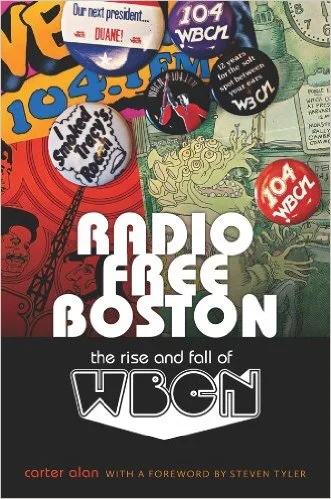
I also discovered that there is a neat, well-written book, "Radio Free Boston" by Carter Alan, which traces end-to-end the fascinating history of WBCN, from its very first show, which opened with Cream's "I Feel Free", to its last, which closed with "Video Killed The Radio Star".
As 2015 winds down, it is customary and right that we take a moment to remember all those who died this year, and I wanted to be sure that Vincent Musetto, longtime news editor and film critic at the New York Post, was not forgotten. He wrote, on deadline, the finest headline ever.


The Girl Groups of the 1960s helped cement themes in American pop that have stuck to this day: glamour, adolescence, scandal, and the tension between capturing old, universal sentiments and instituting new ones. Ronnie Spector, of the pivotal group the Ronettes, was, and still is, an easy choice for poster girl. At seventy-two, she remains sinuous and spritely; sharpened by adversity, she is emblematic of those volatile sixties, which look more familiar with each turbulent, new headline. These days, Spector sits between songs, but her exuberant performances are a lesson in pop history. She promises the “Best Christmas Party Ever” at City Winery, Dec. 22-23; with standards like “Be My Baby” and classic renditions of “Sleigh Ride” and “Frosty the Snowman,” it’s a hard holiday evening to beat. [The New Yorker]
There was a weekend during the Summer of 1968, walking along one of the streets on the back side of Beacon Hill, when it seemed like everybody was playing the new Big Brother And The Holding Company album. You couldn't go more than twenty feet without hearing "Piece Of My Heart" or "Ball And Chain" coming from an open apartment window. The summer before, you would have been hearing the Red Sox game during their "Impossible Dream" season, but this summer, back in the time when nobody on that part of The Hill had an air conditioner in the window, it just seemed like everyone discovered Janis Joplin at the same time.
The West Coast had discovered Janis the year before at the Monterey Pop Music Festival, but it took a year for the word to spread, and for a major record label like Columbia to put their advertising support behind the group, creating a national audience and making it possible for them to tour behind the release of the album. All of a sudden, it was in the Summer air, everywhere.


So I bought my copy of the album for $2.79 at The Harvard Coop on Saturday, and immediately put it into constant rotation on our KLH stereo all weekend long.
Janis' story has become so trite and cliche over the years - the Jack Daniels, the outrageous outfits - that those generations who never had the opportunity to see her live in concert have no idea what they missed. Before her depression and substance abuse killed her, she was totally in control of her music and her performances.
Here she is at her peak. Mama Cass' reaction perfectly captures the moment.

A cabbie picks up a Nun. She gets into the cab, and notices that the VERY handsome cab driver won’t stop staring at her. She asks him why he is staring.
He replies: “I have a question to ask, but I don’t want to offend you.”
She answers, “My son, you cannot offend me. When you’re as old as I am and have been a nun as long as I have, you get a chance to see and hear just about everything. I’m sure that there’s nothing you could say or ask that I would find offensive.”
“Well, I’ve always had a fantasy to have a nun kiss me.”
She responds, “Well, let’s see what we can do about that…
1) You have to be single and
2) You must be Catholic.”
The cab driver is very excited and says, “Yes, I’m single and Catholic!”
“OK” the nun says. “Pull into the next alley.”
The nun fulfills his fantasy with a kiss that would make a hooker blush. But when they get back on the road, the cab driver starts crying.
“My dear child,” said the nun, “why are you crying?”
“Forgive me, but I’ve sinned. I lied and I must confess, I’m married and I’m Jewish.”
The nun says, “That’s OK. My name is Kevin and I’m going to a Halloween party!”
I've been watching CNN's very good series about the 1970s, which is a difficult decade to relive in many ways. But one aspect of it in particular has stood out to me throughout all the segments: how much more focused and serious network news coverage was at the time.
At the end of the episode about the winding down of the Vietnam War, John Chancellor and, especially, David Brinkley put everything into perspective, in a way I'm afraid is no longer possible on commercial television.

No, I haven't disappeared or been abducted by ancient aliens, although prior to the kickoff of the NFL regular season this past weekend, I did find myself watching that show on the History Channel. I don't think that was good for me.
I just "decided" to take the second half of my Summer off. Because I could. And because I had allowed myself to become more of a consumer than a creator of content, and that always tends to sap my energy. Commenting on Facebook, Twitter and other threads is a lot like eating junk food - it provides an ephemeral thrill, but it slows you down, and an hour later you have nothing to show for it except "likes" and "retweets" if they matter to you.
I need to be writing and creating content again, curating and synthesizing stuff that interests me, satisfying my curiosity, and sharing it with my small circle of friends.
Clara Bow, 1930


I recall that it was a blustery, cold Halloween night in 1969 when we went to see The Band in concert. We'd toked up pretty good inside a friend's car, in a parking spot we'd miraculously found on Saint Stephen Street, directly behind Symphony Hall. Normally we would have taken the Red Line then the Green Line to Symphony Hall from our Beacon Hill apartment, but I guess whoever we went to the concert with had wheels, and we were happy not to have to stand outside and smoke in the cold. Second-hand smoke under these circumstances is a good thing.
The concert at Symphony Hall that night was The Band, touring behind their second album. The surprise, unbilled opening act was Van Morrison, who was living on the other side of the river in Cambridge at the time and who I don't think we'd ever heard of. I believe the ticket price was $5.00, which was a lot of money in those days, considering the fact that I was making $1.25 per hour at my job at The Book Clearing House on Boylston Street. (Gail supplemented our income with her job at Harvard Divinity School.) The monthly rent for our apartment was $100, and we were living large enough to take a two-week vacation in England that year, which included a stop at the Isle Of Wight festival. We didn't have to worry about where our next smoke would come from, and we always seemed to have a little money left over each month at Suffolk Franklin Bank. (We paid for that UK vacation in advance, in cash.) Good times indeed.

What immediately caught our attention inside Symphony Hall once we'd found our seats (stage right with an excellent view down to the stage) was the massive array of speakers and other assorted sound equipment deployed on the stage, and what are now called "sound technicians" (we called all non-band members of rock groups "roadies" or "groupies") scurrying about, communicating with the engineer at the sound board in the back of the hall, getting the sound levels just right. We had never before seen such attention to detail at a concert; we soon discovered why it was all so important, and how The Band was different from all the other live performers we had seen up to this point.
Van Morrison was introduced by Robbie Robertson, and proceeded to play very strong set, considering that he was completely blotto. A bottle of Jack Daniels sat precariously on top of one of the Marshall speakers, and I suspect alcohol was not the only agent in his system that night. As loud as the sound was - and the sound at rock concerts back then (as now) was loud - it was crisp, clear, and just about perfect (except for the slurred lyrics on Van's part). "Into The Mystic" blew our minds.
Van ended his set passed out on the stage. On the Queen's birthday in 2015, he became "Sir Van". And so it goes...

As for the Band, their set was astonishing. Every note sounded just like it did on their albums. We had never before experienced that kind of precision and absolutely perfect renderings of music that we were intimately familiar with from countless listenings on vinyl, and through reasonably good stereo speakers, given the state of home audio technology in the 1960s. (Now of course, everything sounds incredible right through the headphones attached to your phone.)
But then, we had no reason expect to hear the lyrics sung clearly and balanced with the instruments. Part of it can be attributed to the marvelous acoustics of Symphony Hall, of course, but most of it was accomplished through the sophisticated application of technology and a commitment to excellence on the part of the artists, as well as pride in this amazing body of work they had created.
It was a magical evening.
This photograph perfectly captures the state of the Boston Red Sox tonight, having coughed up a seven-run lead to the Toronto Blue Jays.


